Every year, dozens of workers are injured or killed during routine maintenance because machinery unexpectedly powers on. These aren’t freak accidents—they’re preventable failures in one critical process: lockout and tagout (LOTO). When a conveyor restarts during servicing, or a press activates while being adjusted, the results are catastrophic. The lockout and tagout procedure exists to eliminate these risks by ensuring machines stay de-energized during maintenance.
This isn’t just about compliance. It’s about building a culture where energy isolation is treated with the same seriousness as wearing a hard hat. Whether you manage a manufacturing line, oversee maintenance crews, or operate heavy equipment, understanding the full scope of LOTO isn’t optional.
What Is Lockout and Tagout?
Lockout and tagout refers to a standardized safety process used to control hazardous energy during servicing or maintenance of machines and equipment. It involves two key actions:
- Lockout: Physically isolating energy sources using locks—such as padlocks on disconnect switches, valves, or circuit breakers.
- Tagout: Applying warning tags that identify who locked the equipment, when, and why.
Together, they prevent accidental or unauthorized re-energization. OSHA defines LOTO under 29 CFR 1910.147, which applies to any equipment that could release stored energy—electrical, mechanical, hydraulic, pneumatic, chemical, or thermal.
Real-world scenario: A technician clears a jam in a packaging machine. Without LOTO, a coworker resets the control panel, restarting the system. The technician’s hand is crushed. With LOTO, the machine’s power source is locked and tagged—no restart possible until the lock is removed by the authorized person.
Key Elements of an Effective LOTO Procedure
A successful lockout and tagout procedure is not just about slapping on a lock and tag. It’s a documented, repeatable process with specific components:
1. Energy Control Plan Every facility must have a written energy control program outlining procedures for each machine. This includes identifying all energy sources (e.g., main power, backup batteries, pressurized lines) and specifying isolation points.
2. Authorized vs. Affected Employees
- Authorized employees perform LOTO and must be trained to recognize and control hazardous energy.
- Affected employees operate or use equipment but don’t perform maintenance. They must understand when LOTO is active and why they can’t interfere.
3. Lockout Devices and Tags Devices must be durable, standardized, and identifiable. Tags must include: - Employee name - Date and time - Reason for lockout - Department or crew
Using non-standard locks (like personal padlocks not part of the system) undermines the entire process.
4. Periodic Inspections OSHA requires annual inspections of LOTO procedures. A trained auditor observes a full cycle and checks for compliance gaps. Findings must be documented and used to improve training or procedures.
Step-by-Step Lockout and Tagout Procedure
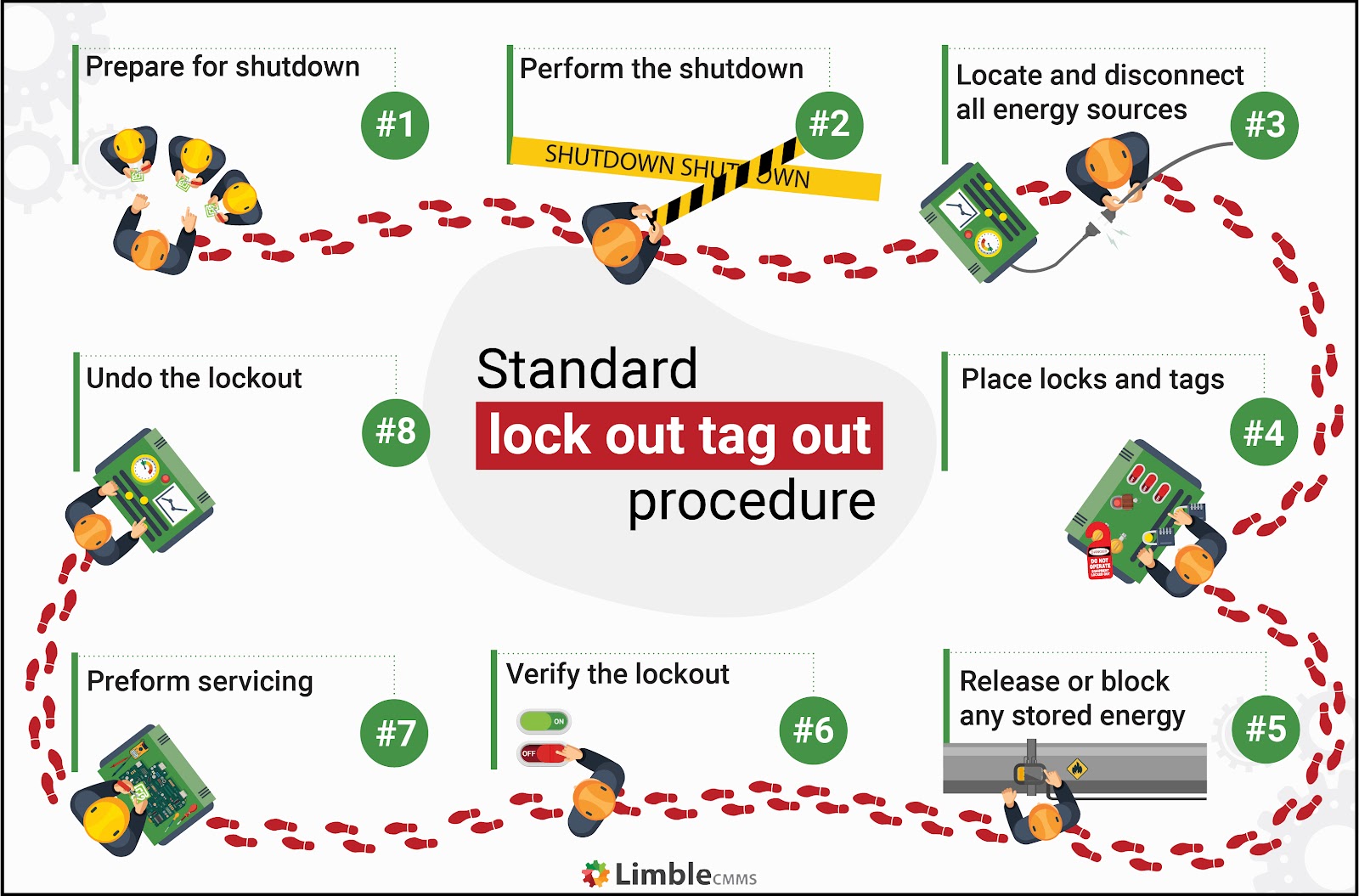
Following a precise sequence is critical. Deviation—even skipping one step—can lead to disaster. Here’s the standard seven-step process:
- Notify Affected Personnel
- Inform all relevant workers that maintenance is about to begin and equipment will be shut down.
- Shut Down Equipment
- Use normal stopping procedures. Never assume power is off—verify.
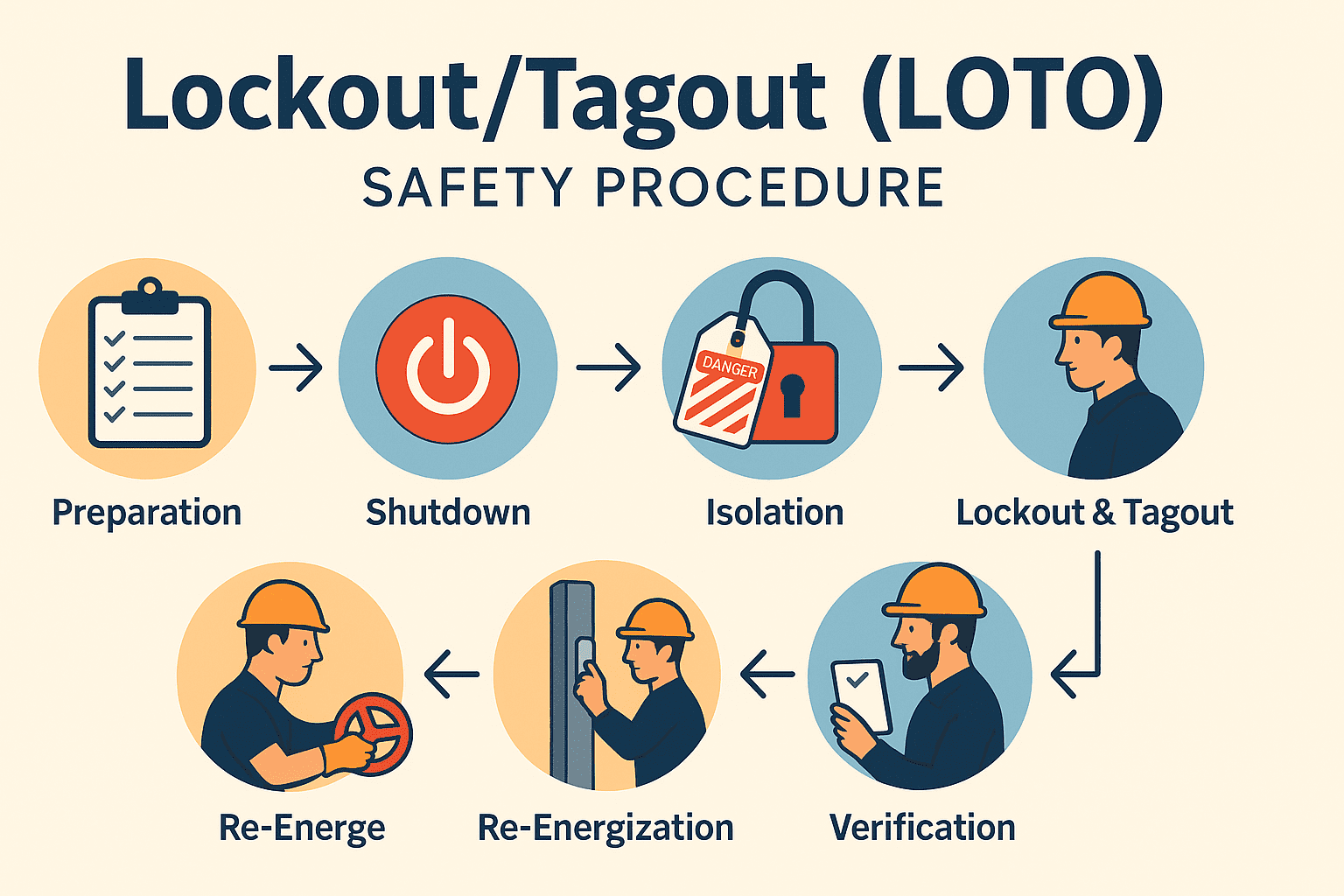
- Isolate Energy Sources
- Disconnect all energy supplies: shut off breakers, close valves, block moving parts. This includes secondary sources like capacitors or springs.
- Apply Lockout/Tagout Devices
- Each authorized employee applies their personal lock and tag. Multiple workers = multiple locks (group lockout).
- Release Stored Energy
- Bleed pressure, drain fluids, block gravity-fed components, or discharge capacitors. Stored energy kills even when primary power is off.
- Verify Isolation (Zero Energy State)
- Attempt to restart the machine using normal controls. If it operates, the lockout failed. If not, energy is successfully isolated.
- Perform Maintenance & Remove LOTO
- After work is complete, ensure tools are removed, guards reinstalled, and area cleared. Only the person who applied the lock should remove it.
Common mistake: Skipping verification. One plant assumed a press was de-energized, but a hydraulic accumulator still held pressure. When a technician opened a line, the ram dropped—severing fingers. Verification would have prevented it.
Common LOTO Failures and How to Avoid Them
Even with procedures in place, violations happen. Here are frequent breakdowns and how to fix them:
- “I’ll just be quick” mentality
- Workers bypass LOTO for minor tasks like clearing jams. Solution: redefine “maintenance” to include any work inside danger zones. Train teams that no task is too small for LOTO.
- Shared locks or master keys
- Some supervisors hold override keys. This violates OSHA—only the individual who applied the lock can remove it. If someone is absent, formal removal procedures (with supervisor approval and documentation) must be followed.
- Inadequate training
- Training can’t be a one-time session. Refresher courses, language-appropriate materials, and hands-on drills are essential—especially for contractors or temporary staff.
- Missing energy sources
- A machine may have electrical, pneumatic, and gravity-based risks. A complete energy survey is required for every piece of equipment.
When Tagout Is Used Alone (And When It’s Not Enough)
Tagout without lockout is permitted only if the employer can prove the tag provides equivalent protection. However, OSHA strongly favors lockout because tags can be ignored or removed.
Permissible tagout-only cases: - Equipment design doesn’t allow lock application (e.g., certain circuit breakers) - Tags are part of a comprehensive supplemental control system (redundant warnings, continuous monitoring)
Supplemental measures may include: - Removal of isolation circuit elements - Blocking of control circuits - Use of positive opening switches
If any of these aren’t feasible, lockout is required. Relying solely on tags increases risk significantly.
Equipment-Specific LOTO Challenges
Not all machines follow the same pattern. Complex systems demand tailored solutions.
Conveyor Systems
- Multiple drive points and tension zones
- Required: Lockout at main motor, gearboxes, and any auxiliary drives
- Risk: Slack sections can snap back under tension
Hydraulic Presses
- Stored energy in accumulators and rams
- Required: Shut off pump, bleed lines, block ram movement
- Risk: Thermal expansion re-pressurizing lines hours later
Boilers and Steam Systems
- Residual heat and pressure
- Required: Isolate steam, fuel, and water; vent and cool down
- Risk: Scalding from delayed release
Each piece of equipment needs a dedicated LOTO checklist. Generic procedures fail under real conditions.
Group Lockout: Coordinating Multiple Workers When several technicians work on one machine, a group lockout strategy is essential. Here’s how it works:
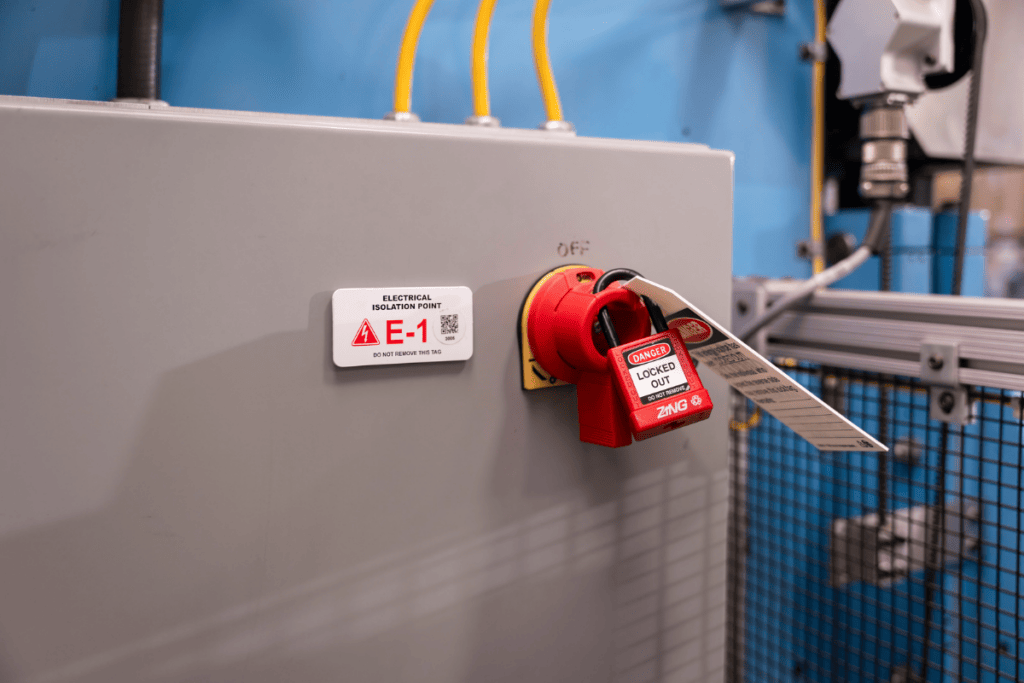
- A primary authorized employee (often a supervisor or lead tech) applies a master lock to the energy-isolating device.
- Each worker attaches their personal lock to a group lockbox or hasp.
- No one can restart the machine until every individual removes their lock.
- Tags must clearly identify each worker.
Critical rule: Never remove another person’s lock. If someone leaves before finishing, follow documented out-of-service removal procedures—never force a bypass.
LOTO Compliance: More Than OSHA Boxes
Meeting OSHA standards is the baseline, not the ceiling. True compliance means: - Up-to-date written procedures for every machine - Regular audits with corrective actions - Training records for all affected and authorized staff - Availability of proper lockout devices (locks, tags, hasps, breaker locks)
But beyond compliance, leading facilities go further: - Digital LOTO systems with QR-coded tags for tracking - Integration with work permit software - Visual dashboards showing real-time lock status
One automotive plant reduced LOTO violations by 70% after introducing color-coded locks by department—making non-compliance immediately visible.
Build a LOTO Culture, Not Just a Procedure
The best LOTO program fails if workers see it as a paperwork exercise. To make it stick:
- Leadership participation: Supervisors should perform LOTO visibly and consistently.
- Peer accountability: Encourage team members to call out unsafe behavior, no matter the rank.
- Near-miss reporting: Celebrate reports of close calls—use them to improve systems.
- Simplify access: Keep lockout kits nearby, not locked in a distant office.
One food processing facility installed “LOTO stations” near high-risk machines—each stocked with locks, tags, and printed procedures. Downtime for setup dropped by 40%, and compliance rose to 98%.
Final Steps to Strengthen Your LOTO Program
Lockout and tagout isn’t a set-it-and-forget-it policy. It demands constant attention. Start here:
- Audit your current procedures against OSHA 1910.147.
- Conduct a full equipment energy survey.
- Retrain all affected and authorized employees—with practical drills.
- Implement annual third-party inspections.
- Replace outdated tags, locks, or hasps.
Machines don’t warn before they kill. But your LOTO program can. Make it bulletproof.
FAQ:
What is the difference between lockout and tagout? Lockout uses physical locks to isolate energy sources; tagout uses warning tags. Lockout is preferred because it provides a physical barrier.
Who is responsible for applying the lockout device? The authorized employee performing the maintenance must apply their own lock and tag.
Can you use tagout without lockout? Only if the equipment design prevents lock application and additional safety measures are in place.
How often should LOTO procedures be inspected? OSHA requires at least annual inspections, conducted by a trained auditor who observes a full cycle.
What happens if a worker forgets to remove their lock? A formal removal process must be followed, including verification that the person is not on-site, attempts to contact them, and supervisor authorization to remove the lock.
Do LOTO procedures apply to corded tools? Yes, if the tool is being serviced and could be energized unexpectedly. Unplugging and locking the outlet or circuit is required.
Is training required for LOTO? Yes. Authorized employees must be trained on energy control procedures. Affected employees must understand the purpose and limitations of LOTO.
FAQ
What should you look for in Lockout and Tagout Procedure: A Complete Safety Guide? Focus on relevance, practical value, and how well the solution matches real user intent.
Is Lockout and Tagout Procedure: A Complete Safety Guide suitable for beginners? That depends on the workflow, but a clear step-by-step approach usually makes it easier to start.
How do you compare options around Lockout and Tagout Procedure: A Complete Safety Guide? Compare features, trust signals, limitations, pricing, and ease of implementation.
What mistakes should you avoid? Avoid generic choices, weak validation, and decisions based only on marketing claims.
What is the next best step? Shortlist the most relevant options, validate them quickly, and refine from real-world results.