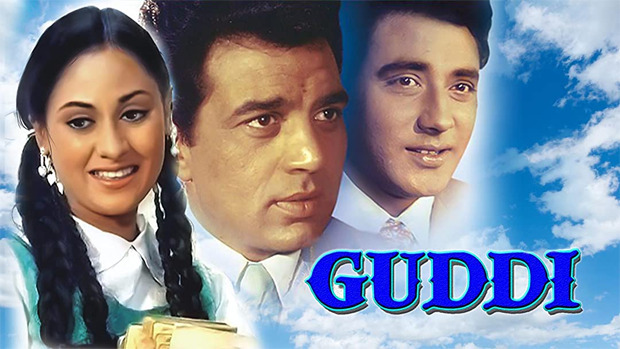
Hema Malini is synonymous with Guddi—her wide-eyed charm, mischievous smile, and breakout performance defined the 1970s classic. But before she ever stepped onto the set, another actress was quietly signed to play the dreamy young girl fascinated by stardom. The real story behind Guddi’s casting reveals how close Bollywood came to a very different version of cinematic history.
Few know that the role of Guddi—the schoolgirl obsessed with film heroines—was initially promised to someone else. The decision was made, contracts discussed, and preparations subtly underway. Then, in a twist common to the industry but rarely documented, the project pivoted. Understanding who was first cast, why the change happened, and what it meant for the film’s legacy offers a rare glimpse into the fragile mechanics of casting in Indian cinema.
The Original Choice: Jaya Bhaduri
Long before she became Jaya Bachchan, Jaya Bhaduri was a rising starlet, trained at FTII and already making waves with her naturalistic performances. She was director Hrishikesh Mukherjee’s first instinct when casting Guddi. Her understated elegance and ability to portray innocence without naivety made her an ideal fit for the character—a young woman navigating fantasy and reality.
Mukherjee had worked with Jaya in Anand (1971), where her restrained performance opposite Amitabh Bachchan earned critical praise. He trusted her ability to carry emotional nuance, a necessity for Guddi’s arc—from starry-eyed fan to a matured young woman confronting illusion.
By most insider accounts, Jaya had verbally agreed to the role and preliminary discussions with the production team were underway. Wardrobe fittings and makeup tests were tentatively scheduled. It wasn’t a rumor—it was a near-lock.
Why Jaya Bhaduri Stepped Away
Jaya didn’t drop out due to creative differences or scheduling conflicts. The reason was far more personal: she was pregnant with her first child, Abhishek Bachchan. At the time, pregnancy in leading actresses was rarely accommodated in mainstream filmmaking. Roles were recast swiftly, often without public explanation.
Rather than delay production or risk continuity issues, Jaya made the quiet but firm decision to step aside. There was no drama, no public fallout—just a professional exit that allowed the film to move forward. Mukherjee, known for his calm demeanor, accepted the situation without resistance.
This moment underscores a recurring issue in 1970s Bollywood: the lack of infrastructure for actresses during life transitions. Unlike today, where shooting schedules are adjusted or roles written around personal events, back then, stepping away often meant losing the part for good.
Enter Hema Malini: A Star in the Making
With Jaya out, the search reignited. Hema Malini, already established as the “Dream Girl” of Indian cinema, was not the obvious choice. She was known for glamor and stylized roles—not the kind of grounded, relatable characters Mukherjee favored.
But someone on the team—accounts vary between producer Gulzar and cinematographer Jaywant Pathare—suggested Hema with a compelling argument: her off-screen persona mirrored Guddi’s fascination with cinema. Hema had grown up idolizing actresses, dreaming of stardom. Playing Guddi wasn’t acting—it was autobiography.
That insight convinced Mukherjee. He met with Hema, tested her in a simple classroom scene, and was struck by her ability to switch from playful to vulnerable in seconds. Unlike her usual screen presence, here she was unguarded, spontaneous.
Hema brought a unique duality to the role: the wide-eyed fan and the sharp, questioning young woman beneath. Her chemistry with Dharmendra—then a rising romantic lead, later her real-life husband—added another layer of authenticity, especially in the film’s dream sequences.
How the Casting Shift Changed the Film’s Trajectory
Had Jaya played Guddi, the film would likely have leaned more introspective, quieter. Her strength lay in subtlety—minimal expressions, maximum emotion. The result might have been a more somber, art-house take on fandom.
Hema’s version, while still thoughtful, had energy, rhythm, and pop. Her performance elevated the song sequences—particularly “Bholi Surat Dil Ke Geet,” where fantasy and reality blur. The dance numbers weren’t just entertainment; they were narrative tools, showing how Guddi internalizes cinematic fantasy.
Moreover, Hema’s star power helped market the film. Guddi wasn’t just a critical success—it was a box office draw. Her casting bridged the gap between parallel cinema and mainstream appeal, a hallmark of Mukherjee’s later works.
This pivot also reshaped Hema’s career. Before Guddi, she was seen as a glamorous dancer. After, she was taken seriously as an actress capable of depth. The role opened doors to more complex characters in films like Sholay and Kinara.
Behind the Scenes: Dharmendra’s Role in the Casting
Dharmendra, who played the fictionalized version of himself in Guddi, had no say in the initial casting. But once Hema was on board, his presence became a narrative wildcard.
At the time, rumors of their off-screen romance were swirling. When audiences saw them together—Hema as the infatuated fan, Dharmendra as the charming hero—they saw more than fiction. They saw possibility. The meta-layer added emotional weight.
There’s a well-documented scene where Guddi watches Dharmendra’s films on loop. In real life, Hema had done the same. That blurred line between performance and lived experience gave the film a rare authenticity. No script rewrite could have engineered that.
Why This Casting Story Matters Now
Today, with casting transparency and fan-driven campaigns, it’s easy to forget how arbitrary early decisions could be. One pregnancy, one suggestion, one test shot—and cinematic history shifts.
Guddi’s casting reveals three enduring truths:
- Timing is everything. Jaya’s exit wasn’t a rejection—it was circumstance. Yet it altered two careers.
- Stars can surprise you. Hema defied typecasting and delivered a layered performance.
- Behind every iconic role, there’s an alternate timeline. The actor who didn’t get the part is often as important as the one who did.
This isn’t just trivia—it’s a lesson in how fragile and fluid creative decisions are. For aspiring actors, it’s a reminder: rejection isn’t always about talent. For filmmakers, it’s a call to build flexible systems that don’t force personal sacrifices.
What If Jaya Had Stayed?
Imagine Guddi with Jaya Bhaduri. The film might have emphasized internal conflict over musical fantasy. The tone could have leaned into realism, with fewer dream sequences and more dialogue-driven moments.
Her version of “Bachna Ae Haseeno” might have been sung with wistfulness rather than wonder. The climax—where Guddi confronts the illusion of stardom—might have felt more like resignation than awakening.
And critically? The film may not have crossed over to mass audiences. Jaya, though brilliant, didn’t have the box office pull Hema brought in 1971. Guddi might have remained a cult favorite rather than a cultural touchstone.
Hema’s casting didn’t just fill a gap—it redefined the film’s identity.
Final Takeaway: Casting Is Chemistry, Not Just Credentials
The story of who was first signed to play Guddi isn’t about who lost—but how cinema thrives on unexpected turns. Jaya Bhaduri would go on to deliver legendary performances in Abhimaan, Kabhi Kabhie, and Guddi’s spiritual successor, Gharaonda.
Hema Malini made Guddi her own, turning what could have been a minor role into a career-defining moment.
The real answer to “guess which actor was first signed up to play Guddi” isn’t just a name—it’s a reminder that film is shaped as much by life’s accidents as by artistic intent. In an industry obsessed with control, sometimes the best choices are the ones you didn’t plan.
For creators, actors, and fans: stay open. The role you’re meant for might come from a door someone else had to close.
Frequently Asked Questions
Who was originally cast as Guddi before Hema Malini? Jaya Bhaduri (later Jaya Bachchan) was the first choice and had informally accepted the role before stepping away due to pregnancy.
Why did Jaya Bhaduri leave the role of Guddi? She was pregnant with her first child, Abhishek Bachchan, and chose to step down to prioritize her family, as film schedules rarely accommodated such personal events at the time.
Did Hema Malini audition for Guddi? Yes, she auditioned with a classroom scene that showcased her ability to balance innocence and emotional depth, convincing director Hrishikesh Mukherjee she was right for the role.
How did Hema Malini’s casting change the film? Her star power and real-life connection to fandom added energy and authenticity, broadening the film’s appeal and enhancing its musical and dream-sequence elements.
Was there tension between Jaya Bhaduri and Hema Malini over the role? No evidence suggests any conflict. Both actresses have spoken respectfully of each other, and the transition was handled professionally by the production team.
Could Jaya Bhaduri have played Guddi differently? Yes—her performance would likely have been more internal and restrained, potentially shifting the film toward a quieter, more dramatic tone.
Is the story of the original casting widely known? It’s a lesser-known piece of Bollywood trivia, discussed mainly in film circles and retrospectives, but not widely publicized during the film’s release.
What mistakes should you avoid? Avoid generic choices, weak validation, and decisions based only on marketing claims.
What is the next best step? Shortlist the most relevant options, validate them quickly, and refine from real-world results.